I read El Diseño a su Servicio shortly after finishing Diseño Rentable, and the two books work well as a pair. Where the first taught me to think about design as a management discipline, this one pushed me further — into the question of what design actually means when there is no physical object to show for it.
Viladás starts from a premise that sounds obvious but has significant consequences: a service is not an intangible product. It is something structurally different. And treating it as though it were a product — just harder to hold — is one of the most common and costly mistakes an organisation can make.
That distinction is, for me, the core of the book.
A service is a system, not a thing
In a product, you can separate design, fabrication, distribution and use into reasonably distinct phases. In a service, those boundaries dissolve. The user participates in the delivery. The service unfolds in time, depends on context, and can change depending on who provides it, when and how.
This leads Viladás to a reframing that I find genuinely useful: instead of asking what is our product?, the more productive question is what system of activities makes it possible for the client to obtain value? That shift — from thing to system — changes how you approach almost every problem.
For a consultant, this matters enormously. Many engagements that look like communication or branding problems are, underneath, service design problems. The message is not the issue. The system that delivers it is.
The holistic approach versus the mechanistic one
Viladás draws a distinction between two ways of understanding service design that I keep returning to in practice.
The mechanistic approach focuses on processes, touchpoints, sequences and efficiency. It is useful — but it risks turning a service into an industrial chain, optimising individual components while missing how they interact.
The holistic approach treats the service as a system where users, employees, suppliers, technology, organisation and environment are all interdependent. Changing one element changes others. Optimising one part can break another.
Most organisations default to the mechanistic view because it is easier to manage. The holistic view requires a different kind of attention — and a different kind of consultant.
You design the conditions, not the experience
Here is an idea from the book that I think about often.
A company can control its processes, interfaces, spaces, communication, personnel, technology and physical evidence. What it cannot fully control is the experience the user actually has. The experience emerges from the interaction between what the organisation provides and what the user brings — their expectations, their mood, their context, their previous experiences.
This means there is a crucial distinction between designing the delivery and designing the experience. A service can function perfectly from an operational perspective and be genuinely poor from the user's perspective. Viladás pushes designers — and by extension, consultants — to keep both in view simultaneously.
Prototyping is not about proving you are right
One of the most practically useful ideas in the book concerns the role of prototypes, scenarios and storyboards in service design.
Most people use prototypes to demonstrate that a solution works. Viladás reframes this completely: the purpose of prototyping is to discover why it might not work — to make visible the assumptions buried in the design before they become expensive errors in production.
This is a fundamentally different relationship with uncertainty. A prototype is not evidence. It is a question made physical.
I have found this reframing useful well beyond service design. In strategy, in communication, in institutional work — the habit of building something small and exposing it to reality before committing fully is one of the most valuable things a consultant can practise.
The designer as mediator
Perhaps the most interesting idea in the book about professional identity is Viladás's suggestion that the designer's role shifts — from author to mediator.
In the classic model, the designer has the vision and executes it. In service design, the designer must bring together users, clients, engineers, operations, management and technology to build a solution collaboratively. The value is no longer in the individual idea — it is in the capacity to hold a complex system together and help different actors find a shared direction.
This anticipates much of what we now call facilitation, co-creation and systemic thinking. And it describes something that is equally true of good consulting: the work is not always about what you know. It is often about what you can help others see.
A note on where the book shows its age
El Diseño a su Servicio was published in 2010, and it is worth reading with that in mind. Many of its tools and concepts — customer journey mapping, blueprinting, personas, co-creation, user research — have since become standard practice in UX, CX and innovation consultancy. The book deserves credit for introducing them accessibly in Spanish, but they are no longer novel.
More importantly, Viladás herself acknowledges a limitation that remains unresolved: demonstrating the specific economic value that service design generates is genuinely difficult. The argument that service design creates value is, by now, widely accepted. The more interesting professional question is: where exactly is that value created, and how do we demonstrate it?
That is where this book connects back to Diseño Rentable — and where both of them leave work still to be done.
What I learned from this book
These are the five ideas that have most directly shaped how I work.
Change the question before you propose a solution.
Do not ask what the organisation needs to design. Ask what system of activities makes it possible for the client to obtain value. That reframing reveals problems — and opportunities — that the first question leaves invisible.
A prototype is a question, not an answer.
The purpose of building something early is not to prove the concept works. It is to discover the assumptions you did not know you were making. The cheaper the prototype, the earlier you learn — and the cheaper the mistake.
Design the backstage as carefully as the frontstage.
A great customer experience that the organisation cannot sustainably deliver is not good design. It is a liability. The work visible to the user and the work invisible to them must be designed together — or the system will eventually break at the seam.
The tools are not the point.
A customer journey map does not transform an organisation. A blueprint does not either. What transforms an organisation is the conversation those tools make possible and the decisions they unlock. The tool is an excuse to get the right people in the room.
A service is never finished.
Users change. Expectations change. Technology changes. Competitors change. Designing a service as though it will reach a final stable version is a category error. The right model is iterative — launch, learn, adjust, repeat. The consultant who helps an organisation build that capacity leaves something more valuable than any single deliverable.
Read alongside Diseño Rentable, this book completes a picture: design is a discipline for making better decisions under uncertainty — whether the output is a product, a service, a strategy or a communication. The medium changes. The underlying logic does not.
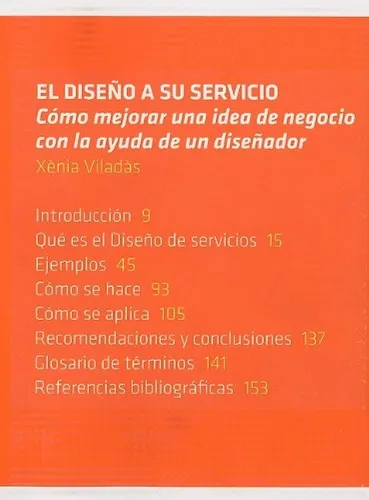
Xènia Viladás, El Diseño a su Servicio: Cómo mejorar una idea de negocio con la ayuda de un diseñador, Index Book, 2010.
Xènia Viladás
El Diseño a su Servicio
Index Book, 2010