Press and Cooper ask a deceptively simple question: what are we actually designing when the thing we are designing cannot be held, stored or shipped?
Their answer reshapes the profession entirely.
Design, they argue, is no longer primarily about creating objects. It is about creating experiences, meanings and relationships between people and organisations. And if what we design changes, then who we are as designers must change too.
That double shift — in the object of design and in the identity of the designer — is the core of the book.
The product is only a fragment of the experience
The opening conceptual move is the most important one.
Consider a hotel. You can design the bed, the room, the logo, the website, the furniture. But the experience of the hotel is none of those things individually. It is the sum of: expectation, search, booking, arrival, check-in, interaction, stay, departure, memory, recommendation.
The object is one component in a longer sequence that begins before contact and ends long after it. Press and Cooper were describing this in 2003, before UX, service design and customer experience became established disciplines. Reading it now, the book feels less like history and more like an origin story — the moment when design started thinking about time, not just form.
For a consultant, the practical implication is significant: many problems that arrive as product or communication briefs are, at a deeper level, experience problems. The object is fine. The system around it is not.
Consumers do not buy utility — they buy meaning
The second major idea concerns what people actually want when they buy something.
A product has an objective function. But it also serves to express identity, signal belonging, project a lifestyle, produce emotion, construct a personal narrative. Press and Cooper draw on consumption culture research to show that perceived value is not inside the product — it is in the relationship between product, person and context.
This has direct consequences for branding. If a brand is an experience, then advertising cannot indefinitely compensate for a poor one. You can say you are fast, but if the process takes twenty minutes, the experience contradicts the communication. You can say you are premium, but if the service is mediocre, the positioning collapses.
Brand, in this reading, equals promise plus real experience. The consulting implication: do not design how the organisation speaks. Design what makes that communication credible.
Research is part of design, not a phase before it
One of the most useful professional ideas in the book concerns the role of research.
The traditional model positions the designer as someone who receives a brief and produces a solution. Press and Cooper propose a much richer cycle: investigate, understand, interpret, formulate, design, communicate, evaluate. Research is not a bureaucratic step before the creative work begins. It is part of the creative process itself — and one of its most important functions is risk reduction.
A designer who researches well can detect: we are trying to solve something that may not be the actual problem.
This reframing has stayed with me. Especially the part about risk. Organisations rarely resist research on principle — they resist it because they do not see the connection between understanding the problem deeply and avoiding expensive mistakes later. Making that connection explicit is one of the most useful things a consultant can do.
Communicating design is part of design
Here is an idea I find consistently underestimated in practice.
An excellent proposal can fail because no one manages to explain it, justify it, visualise it, convince the board, secure the resources or align the stakeholders. The capacity to communicate design decisions is not a soft skill peripheral to the real work. It is part of the professional competency itself.
You need to be able to answer: what am I proposing, why, for whom, what risk does it reduce, what value does it create?
The designer who cannot answer those questions clearly will be excluded from the decisions that matter. And in consulting, where you are always working inside someone else's organisation, this is not a minor limitation — it is the difference between influence and decoration.
The designer as decision participant
Perhaps the most important professional argument in the book is about identity.
The traditional designer receives a brief and executes a solution. Press and Cooper propose something fundamentally different: a professional who interprets problems, investigates, generates opportunities, works across disciplines, argues, facilitates decisions, designs and evaluates. Less executor, more participant in the decisions that shape what gets built.
They even question the concept of the design profession itself — whether its current boundaries make sense in a world where the most interesting problems sit at the intersection of design, research, technology, strategy and management.
That question has only become more urgent since 2007. The designer who tries to maintain a rigid professional boundary is likely to find themselves making things that someone else has already decided. The one who crosses it tends to end up in the room where the decisions are made.
Where the book shows its age — and why it matters
This is where I would be more critical than with Viladás.
In 2003, designing for experience was genuinely novel. In 2026, it is a baseline expectation. UX is institutionalised. CX is a business discipline. Service design is established. Every serious brand thinks about experience ecosystems. The question should we design for experience? has been answered. Nobody is arguing for the alternative.
The more interesting question now is: which experiences deserve to be designed, and what strategic value do they produce?
Because we have also built an industry of absurdly sophisticated experiences that sometimes add nothing but friction, cost and theatricality. Designing for experience is not inherently good. It depends entirely on whether the experience serves a real purpose for a real person in a real context.
That critical lens — which Press and Cooper do not quite reach — is what separates experience design as fashion from experience design as strategy.
What I learned from this book
These are the five ideas that have most directly shaped how I think about my own practice.
The experience starts before contact — and ends after it.
A client already has expectations before they use a product or service. Those expectations are part of the experience. And the memory they carry afterwards shapes whether they return and what they tell others. Designing only the transaction misses most of what actually matters.
Value is relational, not contained.
The value of what we design is not inside the object. It exists in the relationship between the object, the person and the context. This means that identical products can produce radically different values depending on who uses them, when, where and why. Understanding that relationship is the real design challenge.
If you cannot communicate the decision, the decision does not exist.
A proposal that cannot be explained clearly enough to secure resources and alignment is not a complete proposal. Communication is not presentation — it is the last mile of the design process. Treating it as an afterthought is one of the most common ways good ideas fail inside organisations.
Research reduces risk — and that is how you sell it.
Organisations do not resist research because they dislike knowledge. They resist it because they do not see its connection to better outcomes. The consultant who frames research as risk reduction — not as intellectual curiosity — gets it approved.
The boundary of the profession is a strategic choice, not a given.
Design sits next to research, strategy, management, technology and social science. Where you draw the line around your practice determines what problems you get to work on and what decisions you get to influence. Expanding that boundary deliberately — not randomly — is one of the most important professional choices a designer or consultant can make.
This book makes a case that I find genuinely useful: design is a discipline for creating value under conditions of uncertainty — whether the output is a product, a service, a system or an experience. The form changes with each decade. The underlying logic remains the same.
Mike Press and Rachel Cooper, El Diseño como Experiencia: El papel del diseño y los diseñadores en el siglo XXI, Gustavo Gili, 2007.
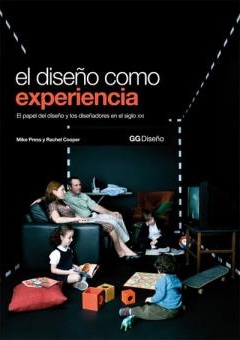
Mike Press & Rachel Cooper
El Diseño como Experiencia
Gustavo Gili, 2007